Moncton Beats Magazine
The food movement of Southeast New Brunswick
  • Home
  • First Issue-2016
  • Posts 2016-2021
  • Food Skills Project
  • Garden Art Lesson Plans
  • CFMs
  • About MB
woman displaying a plan for two older people

Jun 6 2016

Laura Degrace — The Mad Scientist of Workshops


This is Laura DeGrace. Don’t mention a community project idea around Laura unless you’re better than half serious about following through because the next day your inbox will have urgent messages about funding possibilities and probably a list of potential recruits and clients.

Her logic is simple: If the idea resonated enough to tell someone then why wouldn’t you get out there and try to make it happen? Hers is a mindset of making possibilities into realities.

Green Eye Coop

Many of her projects — and there are a lot of them — are about food: cooking it, growing it, supplying it, teaching about it, protecting it. Her flagship is Green Eye Coop, which she says gives some coherence to all the stuff she’s organizing. Creating the co-operative also moved her from mostly volunteer work towards a living income for doing the things she was doing anyway.

Love for Organizing

We take for granted that someone who spends most of their time organizing courses and workshops about food and food security is someone who is obsessed about food and food security. Laura told us that she’s really about organizing. An idea pops into her head, she wants to make it happen. An idea pops into someone else’s head, she’ll get in on organize that too.

And as if she didn’t have enough ideas for workshops, she recently traveled to California with a couple of friends, Janet Hamilton and Jen Hudson, to take a week-long master food and preserving course. So, you can be expecting a swarm of preserving workshops in the near future.

A Gallery of Laura Degrace Activities

woman with cup of tea on shag covered couch
Being out there means always being in the strong light, alway being under scrutiny, even when you're at home.
woman with cup of tea on shag covered couch
Laura Degrace
hands watering a plant
woman digging in cloth bag with her hands
woman passing plant to a child outside
woman showing child and older man compost in a shovel
two women looking at progress of house under construction
woman watching her children play by window in house under construction
Two children squeezing each other out in a tight space

By Elaine and Archie • First Issue, food movement, food security, gardening

three women around table in Cocagne laughing

Jun 6 2016

Seed Saving — A Quiet Act of Defiance

A Little Simple Seed Saving

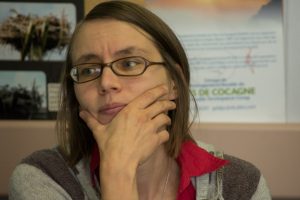
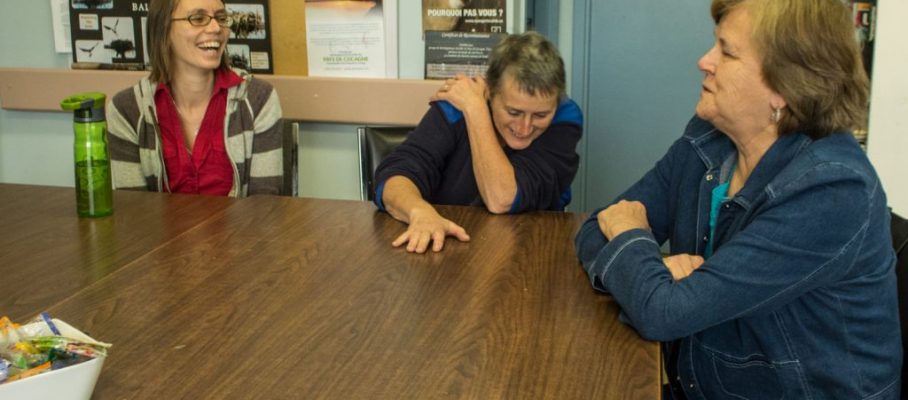
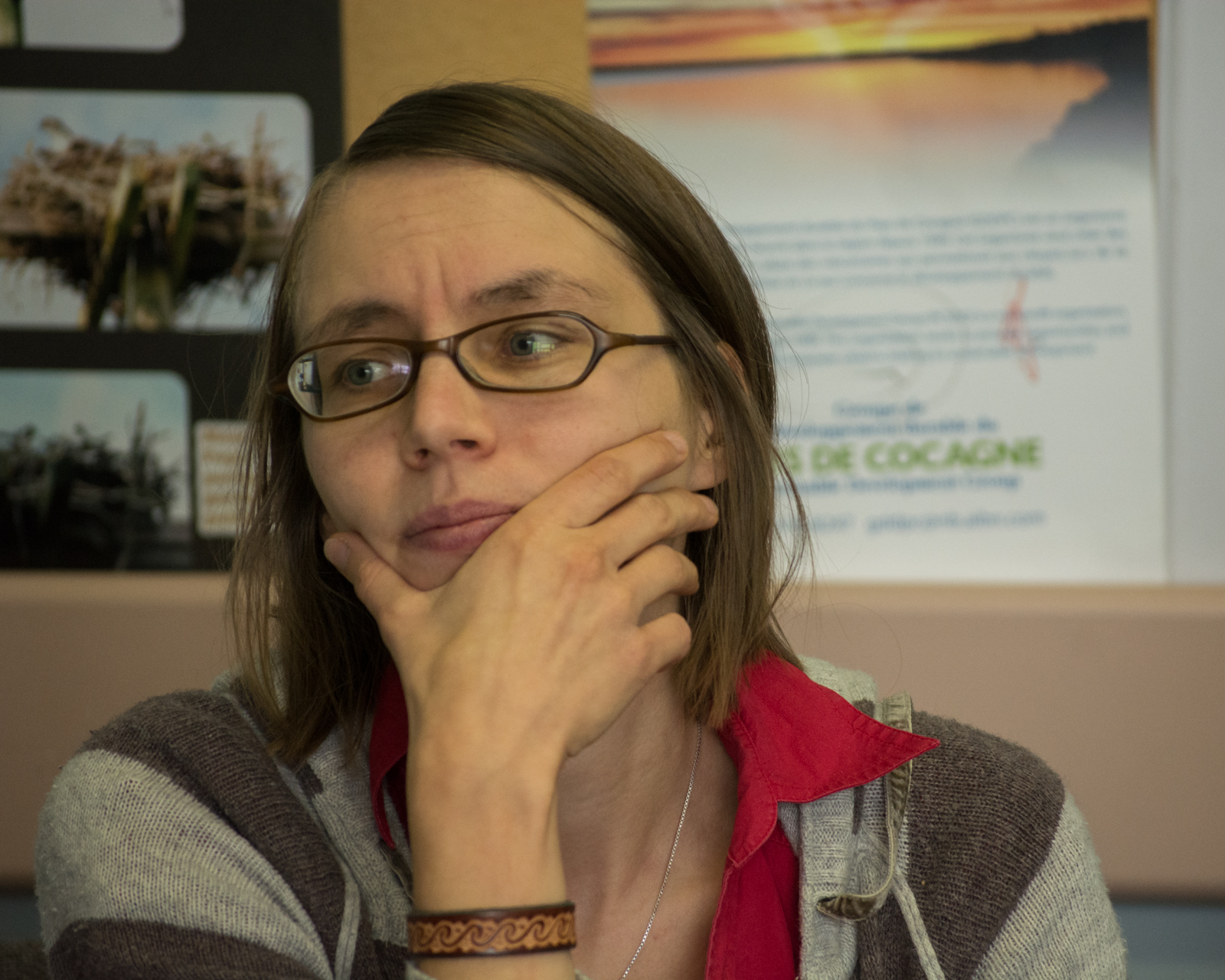
Wiebke Tinney, Bernadette Goguen and Francine Theriault are members of a seed savers group under the umbrella of Groupe du développement durable du Pays de Cocagne (GDDPC). How this tiny community of the Cocagne River Watershed has enough vitality and environmental awareness to even have a such a group is yet to be determined, but it’s exciting and gives me hope.

All three women are full of enthusiasm, stories and information, although Wiebke hangs back a bit in deference to the two veteran seed savers. Francine has been saving for over 15 years, Bernadette seven.

The themes of self sufficiency and independence surface again and again throughout our discussion. They are farmers and are saving seeds to preserve biodiversity, to find varieties that are adapted to climate change, to make seeds available to all — counteracting the Monsanto mentality of patenting seeds and even genes for profit. The seeds savers are generous of spirit.

Francine started with saving seeds for wheat and barley but has also experimented more recently with vegetable seeds. Bernadette grows peppers for their seeds under a subcontract, and Wiebke is just beginning and learning.

It’s a process

Francine holds her cupped hand out and says, “We start out with just a few — and then we multiply our planting every year.” She speaks of the seeds like they are precious gems and of the great patience that is required in observing and choosing the best plants year after year. She just wants people to know that, although it’s not easy, “it’s do-able. It’s a process.”

Seeds cannot be saved from hybrid plants. Instead open pollinated varieties are required. These are seeds that will “breed true” or produce plants that are roughly identical to the parent plants. Seeds from plants that are a result of a recent cross or hybridization will grow into plants with widely different characteristics, or they may be sterile. So they are not suitable.

Seeds from most plants can be saved including grains, peas, beans, tomatoes, peppers, potatoes, squash, pumpkins and broccoli. Some plants like carrots and beets take two years to produce seed.

Great care must be taken when growing plants for seed to keep them away from other, similar varieties so they don’t cross-pollinate and inadvertently produce a hybrid. Francine and Bernadette told of a recent failure of a pumpkin seed that grew into a plant that produced fruit that was a cross between a pumpkin and a zucchini —useless as food or a source of seed.

Growing group

The group estimates there are about 30 people in the area saving a variety of seeds. They hope to get more information about this soon from an online survey.

Bernadette, who is also starting a vineyard says, “We have to own this” meaning the right to save seeds. They shun any government help because in their view government favours big agribusiness.  And these people don’t want to be “beholden.”  Francine says the best way that government can help is to “not get in our way.”

And as for making money from their saving: “No!” is their emphatic answer. That would ruin it, they say. Seed saving is not about making a buck. It’s more about protecting a way of life and safeguarding for the future.

That theme of protecting the future is likely why Bernadette and Francine smiled a lot at Wiebke during the interview. They were clearly delighted that this young person was taking seed saving seriously and wants to learn from them.  It adds richness to their activities and purpose. It adds hope.

It all feels a little bit like they are getting ready to load up the ark for a difficult journey.  These women see what’s coming ahead, but there is no panic. Instead there is quiet, methodical determination…and faith.

A gallery of seed savers
Wiebke Tinney
Wiebke Tinney
Wiebke Tinney
Seed saver
Bernadette Goguen


By Elaine Mandrona • First Issue, food movement, food security, gardening, Uncategorized

man driving a half ton truck

Jun 6 2016

The Farmers Truck — Season 2


Last spring when we heard the rumours of a farmers market on wheels we thought, It’s about time. And obviously so did a lot of other people because The Farmers Truck’s Facebook Page had 4,000 likes before the summer was even out. So popular and timely was the mobile market that people were volunteering to work on it – not a problem most businesses have.

Season 2 promises to be even better with a second, improved truck, an online store complete with home delivery, more products and even, potentially, a performing carrot.

Frederic Laforge and Mathieu Reyjal are the entrepreneurs behind this local business and what we like about them is the solid farming roots they have. Frederic’s father has been a farmer most of his life and Mathieu became a farmer out of university. The idea for The Farmers Truck came out of a professional connection when Frederic was helping Mathieu develop his farm’s logo and brand.

Frederic says the idea came when he was admiring the little country store Mathieu had made at his farm. “But,” he told Mathieu, “it really sucks that I would have to drive out to Cap Pelé. It’d be awesome if it could be mobile.” The discussion started from there.

It took a year of researching, designing, branding, planning and a $25,000 investment to roll out the first truck. Last summer they worked the truck themselves for a month and then hired a crew.

The goal of the truck is an authentic farmers market experience. “To have a little bit of everything,” says Frederic, “so when you get there you can actually get your milk, your cheese, your meat, your vegetables and bread and you go home and have a nice meal. You wouldn’t have to go anywhere else.”

Respect for local farmer

Respect for local farmers is at the heart of their business model. “Back in the day when you were a farmer you were a pillar of the community and now it’s almost like you get looked down on,” Frederic says. “And the retailer is the one who owns the market, dictates what they want to pay for stuff. The one they’re squeezing out is the farmer.”

By contrast, The Farmers Truck sources those farmers as directly as possible and their sources are never more than 160 km (as the crow flies).

Timing is right

The timing of The Farmers Truck business is right not only for consumers, but for local farmers, too. “There have been a lot of changes in food in the Maritimes,” Mathieu says as we’re driving back to their warehouse for more produce for the next rush. It’s the first day of the new season.

For example, Sobeys bought Co-op, he says, and all the contracts for medium-sized farmers got washed away. “All of a sudden all those medium-sized farms are competing with small farmers.”

Back at the warehouse I get the tour. The warehouse is huge and he shows me where their portion is, but there are no walls separating the other spaces. Everything is just getting started at this new location just a couple of minutes from where the truck was on St. George and Cameron. There is a walk-in cooler with a couple of shelving units and there is a space back in the main area where he has a foldout table for a desk.

This is Mathieu’s domain. “Fred is the marketing expert and I’m in charge of logistics,” he says. Mathieu is the one who connects with farmers, a job he obviously relishes, being a farmer himself. However, he has taken the year off farming to put himself completely into The Farmers Truck business.

While he is getting supplies to restock the truck he explains how none of the food will be wasted. If there is anything that doesn’t get bought and won’t keep, the staff can take it or it will go to the new Community Food Centre in Moncton.

New generation of entrepreneurs

These two guys are the new generation of entrepreneurs. They are in it for the money, for sure, and they use all the technology and social media they can; but they believe they must also be doing good for their community. Frederic says they intend to be a B Corporation business whose members are socially responsible. But again, they are a business first.

He says there have been many mobile markets, but most are charities that target food deserts, that is, areas that don’t have access to good grocery stores. While he applauds the idea, he believes that for the business to be sustainable, it must be run as a business.

Franchise opportunities

However, Frederic says, “We don’t want to be in the operating of the truck. Our goal is to franchise.” “We are a retail solution company,” Mathieu says. “The idea is that we are making a product which is a truck and we will make a brand.” Their big goal is that you will be able to buy from a Farmers Truck anywhere across North America.

The core of that franchise, though, will be local sourcing, that is, no industrial food hubs. “Our mission is buy local, sell local. It’s nonnegotiable and we’ll enforce that on our franchisees,” Frederic says. “

Frederic says, “The long term plan is to, say, have a little co-op of farmers, five or six farmers,  and all together they have one truck that they supply and basically they make one-hundred percent of the profit.”

But, he says, “Some of the franchisees won’t be farmers. Maybe they will be young kids who believe in the idea. You can make a decent living having one of these trucks, and encourage your local economy.”

And in the off season, there will be an online store with home delivery to keep franchise owners going when it’s too cold to wait at a truck on the corner.

For now, though, there is only the Moncton operation and they’re still using the first truck they started as a bootstrap operation. But on July 1 the new improved truck should be ready and it will have, among other things, the ability to sell meat.

Tracking them down

Proof of their natural popularity is they barely have to advertise. Most of their marketing is done through their Facebook page where you can track down their location on any given day.

They believe people love that farmers market experience, of buying local and getting good food, and that they will make it part of their grocery buying routine if the The Farmers Truck route is consistent.

A Gallery of Food Truck Photos

man unloading bins
Mathieu loading his truck
man unloading bins
man being interview in a coffee shop
man collecting vegetables at a food truck
woman and man selling produce from a truck
food truck
man at warehouse
hands holding package


By Elaine and Archie • farming, First Issue, food movement, food security

woman in chef's tunic cooking large amounts of food.

Jun 6 2016

This is Janet Hamilton

This is Janet Hamilton. She is the dynamo behind the Mapleton Teaching Kitchen. I met her in June 2015 at a Community Food Mentor workshop. This workshop changed me, renewed my faith in the goodness of people, and she was one of the organizers.

Teaching…Kitchen. Those two words sum up who Janet is. Although a trained chef, you realize after talking to her for a while that she is, first and foremost, always a teacher. She loves to teach, especially teaching the teachers, and has taught many things including first aid and lifeguard certification and now she teaches about food, nutrition and cooking.

She has a lot to say — we spoke with her for over two hours about food security, teaching kids and adults how to cook healthy, inexpensive, simple meals and to make it social and fun. She studied culinary arts at NBCC and worked a few stints as a chef, but using cooking to help affect positive social change appealed to her more than working in fancy restaurants.

Her classes encompass, among other things, one-pot meals, group cooking, food preserving and getting people inspired about good food and making it themselves. She especially loves inspiring kids. because it is often the kids that bring their new skills to their families and there you go, change happens. Often these are kids who have never seen anything cooked from scratch from fresh ingredients, kids who too often ate fast food, processed microwaved food, or nothing at all.

She laughs and smiles a lot and has what I’ll call an Irish sense of humour. I’ll leave it at that. She is also a masterful penny pincher when it comes to food and doesn’t waste a thing. (Students in her classes are soon made the wiser if they try to throw out anything she can use for stock.) She knows where the bargains are and how to make much from little. Another ethic that is passed on to her students.

A Gallery of Janet Hamilton at Work

woman in chef's uniform being applauded
Janet is well regarded in the cooking and food security world in the GMA. Here she is getting a round of applause for her work supplying the food at the Creating a Place for Food workshop in September 2015 put on by Our Food SENB.
woman in chef's uniform being applauded
short woman talking to tall man
woman laughing
chef making food
women speaking to group


By Elaine Mandrona • First Issue, food movement, food security • Tags: cooking, food, food security

alya in her hydroponics tent

Mar 26 2016

This is Alya Nouasri

“Exuberant, creative, bright-eyed, smart and beautiful in so many ways, Alya Nouasri loves to organize and work and advance the social good, like organizing a Community Food Mentor program, which is where I first met her.”— Elaine Mandrona


Last June (2015) Alya Nouasri and the Mapleton Teaching Kitchen’s Janet Hamilton facilitated the first of their two Community Food Mentor (CFM) programs. The CFM program is where participants learn about food security, safety and nutrition, plus grant writing for community food action, and group cooking. Alya was bent on feeding us the best of food and went out of her way to purchase fresh veggies and goodies from Dolma Foods (now resurrected after a January fire) and kept us supplied with vegan almond cookies—always in demand.

Love for good food is from family

Alya’s love and respect for good food come naturally to her. “My grandparents have always been into gardening. My parents have always been into gardening. So it’s always just been in the family.”

Originally from Whitby, Ontario, she says the richness of the soil there meant there was always lots of wonderful produce. “I remember when I was young buying bushels of peaches with my grandmother and canning peaches at our kitchen table and bushels of tomatoes at the end of the growing season and canning tomatoes. So the connection with the growers and the canning process has always been natural.”

When the family moved to New Brunswick, that connection was lost, but now, through her gardening, her volunteering and her workshops, she is helping reconnect people with growers and good food.

Alya is passionate about hydroponics

Alya says that she got involved in hydroponics as a kind of therapy. “I found that during the summer when I was outdoors and gardening – specifically more flower gardens than anything – I was really happy and then I would work in the winter and I would have no garden and it caused a lot of seasonal depression and so the solution was this tent.”

Since then she has become a serious hydroponics gardener, and educator and grows tomatoes, lettuce, eggplant and peppers in her 6 x 6 x 6 Mylar tent. Her dream is to create a huge hydroponics system in an old warehouse or abandoned building that potentially could help feed many Monctonians.

But growing food is just one of three prongs to her dream. The second is an educational component complete with a teaching kitchen, school tours, whatever it takes to share their knowledge with the community.

“The third prong,” Alya says, “is we’d like to be able to share our knowledge with, say, Fredericton or Saint John so that they can replicate what we’re doing here. So it’s like this huge castle but we have to work on it piece by piece.”

And then there are the chickens

And then there are the chickens. She has four chickens — the maximum allowed by law in Moncton — and to listen to the degree of detail she knows about each of their personalities, you’d think she was the parent of four adopted children. But they’re children that supply lots of fresh eggs.

A Gallery of Alya Nouasri

alya with egg plant
Alya shows the quality of food she gets from her small tent.
alya with egg plant
Alya with her chickens
Elaine pouring seeds into alya's hands
alya in her outside garden


By Elaine Mandrona • food security • Tags: community food mentor, food mentor, food security, food sovereingty, hyrdroponics, urban gardening

Mar 7 2016

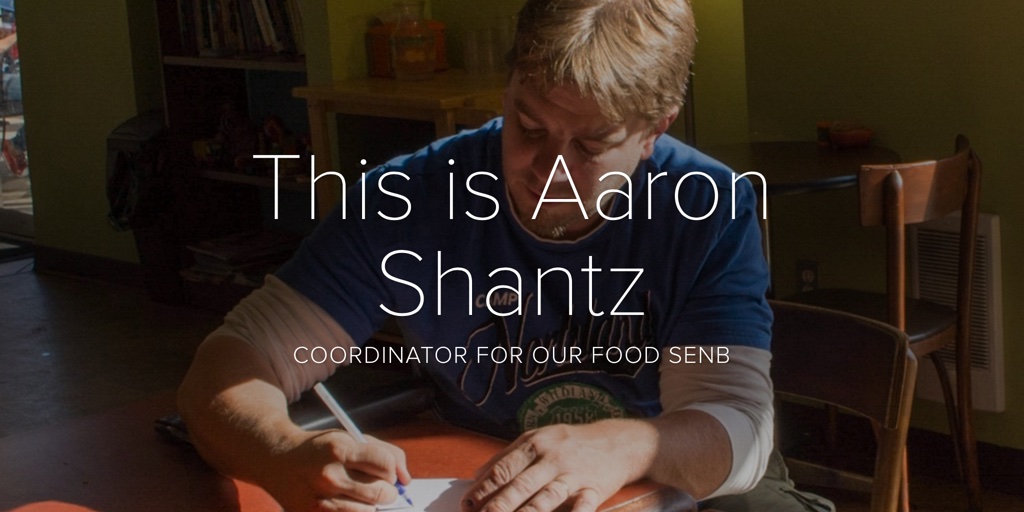
This is Aaron Shantz

Note: The link takes you out of our site, so be sure to come back. This story was done with a free app from Adobe called Adobe Slate. We’re always looking for high quality ways people can get their message across. We’ll review Adobe Slate soon.

This is Aaron Shantz

By Archie Nadon • food security • Tags: community action, community worker, food, Moncton, New Brunswick, protrait

«‹ 2 3 4 5

Categories

  • art
  • children
  • cooking
  • farming
  • First Issue
  • fishing
  • food movement
  • food security
  • food skills project
  • foraging
  • garden art lessons
  • gardening
  • homesteading
  • hyrdroponics
  • people
  • seed saving
  • Uncategorized
  • videos
  • youth care work

Acadie art children community action community food mentor community worker cooking farming food food mentor food security food sovereingty gardening hyrdroponics Moncton New Brunswick protrait Southeast New Brunswick urban gardening

↑

  • First Issue-2016
  • Posts 2016-2021
  • Food Skills Project
  • Garden Art Lesson Plans
  • CFMs
  • About MB
© Moncton Beats Magazine 2025
Powered by WordPress • Themify WordPress Themes